中国稻米 ›› 2026, Vol. 32 ›› Issue (1): 76-81.DOI: 10.3969/j.issn.1006-8082.2026.01.013

• 专论与研究 • 上一篇    下一篇

云南高原特色水稻种植模式的乡村振兴机制分析

蒋鑫1(), 张卫星2, 焦翔3, 沈光宏4,*(), 金连登2,*   

  1. 1中共云南省委党校/云南行政学院昆明 650111
    2中国水稻研究所杭州 310006
    3苏州农业职业技术学院江苏 苏州 215008
    4中国绿色食品发展中心北京 100081
  • 收稿日期:2025-09-16 出版日期:2026-01-20 发布日期:2026-01-13
  • 通讯作者: *amrtc1997@163.com
  • 作者简介:

    #第一作者:80619358@qq.com

  • 基金资助:
    云南省“兴滇英才支持计划”青年人才培养项目(XDYC-QNRC-2023-0463)

Analysis of the Rural Revitalization Mechanisms for Yunnan Plateau’s Characteristic Rice Planting Patterns

JIANG Xin1(), ZHANG Weixing2, JIAO Xiang3, SHEN Guanghong4,*(), JIN Liandeng2,*   

  1. 1Party School of the Yunnan Provincial Committee of the Communist Party of China/Yunnan Academy of Governance, Kunming 650111, China
    2China National Rice Research Institute, Hangzhou 310006, China
    3Suzhou Polytechnic Institute of Agriculture, Suzhou, Jiangsu 215008, China
    4China Green Food Development Center, Beijing 100081, China
  • Received:2025-09-16 Published:2026-01-20 Online:2026-01-13
  • About author:

    #Co-first author: 80619358@qq.com

摘要:

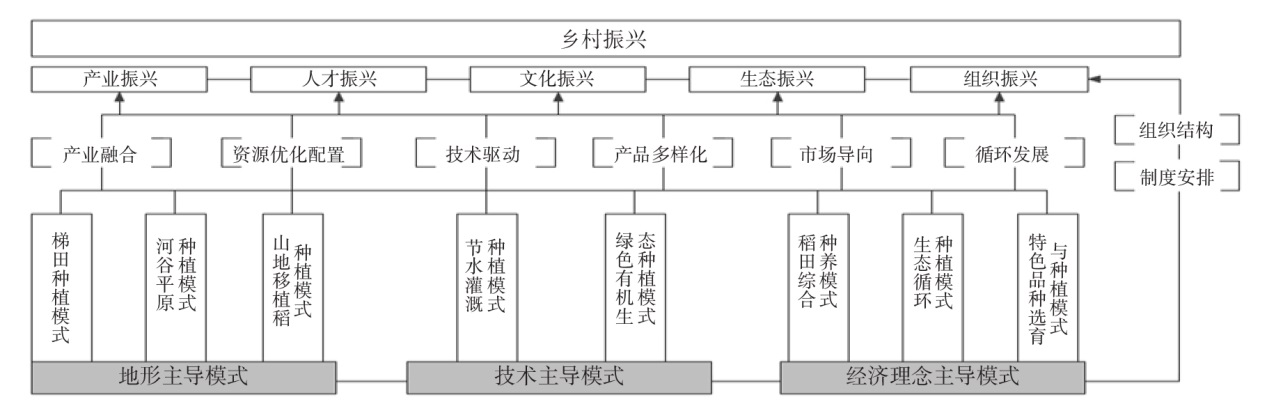
云南以其独特的地理环境享有“稻作王国”的美誉。不过,该地区在水稻发展过程中也遭遇了一系列挑战,诸如农资与劳动力成本居高不下、资源消耗量大、种稻效益偏低等问题。为应对这些难题,当地积极探索并采用了多样化的种植模式,包括梯田种植、河谷平原种植、山地稻旱作、节水灌溉、绿色有机生态种植、稻田综合种养、生态循环种植以及特色品种选育与种植等,显著增强了农业生产的多样性与效率。本文深入剖析了这些种植模式如何有效提升土地利用率、增加农业产出、提高资源利用效率以及增强市场竞争力,进而为乡村振兴注入强大动力。然而,在实践过程中,仍面临一些亟待解决的问题,例如基础设施投入不足、技术推广力度不够、农民技能水平有限、经济成本偏高以及市场认可度较低等。针对以上问题,本文提出以下建议:一是加大基础设施建设投入,改善农业生产条件;二是扩大技术推广范围,加强农民培训,提高农民对新技术的接受与应用能力;三是优化经济成本结构,降低生产成本,提高生产效益;四是加强品牌建设与市场开拓,提升农产品的市场认可度和竞争力,从而推动云南农业实现高质量发展,助力乡村振兴。

关键词: 水稻, 种植模式, 高原特色, 乡村振兴, 云南

Abstract:

Yunnan is renowned as the ‘Kingdom of Rice Cultivation’ due to its unique geographical environment. However, the region has encountered a series of challenges in the process of agricultural development, such as persistently high costs of agricultural materials and labor, significant resource consumption, and relatively low efficiency in rice cultivation. To address these challenges, local areas have actively explored and adopted diversified planting models. These include terrace farming, cultivation in river valleys and plains, upland rice dry farming in mountainous areas, water-saving irrigation, green and organic ecological farming, integrated rice-aquaculture systems, ecological recycling farming, as well as the selection and cultivation of distinctive varieties, which have significantly enhanced the diversity and efficiency of agricultural production. This paper conducts an in-depth analysis of how these planting models effectively improve land utilization rates, increase agricultural output, enhance resource utilization efficiency, and bolster market competitiveness, thereby injecting strong impetus into rural revitalization. Nevertheless, in the course of practical implementation, there are still several pressing issues that need to be resolved. These include insufficient investment in infrastructure, inadequate technology promotion, limited skills among farmers, relatively high economic costs, and low market recognition. In response to these issues, this paper puts forward the following suggestions: first, increase investment in infrastructure construction to improve agricultural production conditions; second, expand the scope of technology promotion and strengthen farmer training to enhance farmers’ acceptance and application capabilities of new technologies; third, optimize the economic cost structure to reduce production costs and improve agricultural profitability; fourth, strengthen brand building and market development to enhance the market recognition and competitiveness of agricultural products, thereby promoting high-quality development of agriculture in Yunnan and contributing to rural revitalization.

Key words: rice, planting patterns, plateau characteristics, rural revitalization, Yunnan

中图分类号: