
中国稻米 ›› 2026, Vol. 32 ›› Issue (4): 43-49.DOI: 10.3969/j.issn.1006-8082.2026.04.008
刘立超1( ), 门龙楠1, 魏中华1, 孙中华1, 宗天鹏1, 沙汉景1, 谢树鹏1,2,3,*()
收稿日期:2025-12-06
出版日期:2026-07-20
发布日期:2026-07-14
通讯作者:
*z15046615666@163.com作者简介:基金资助:
LIU Lichao1(), MEN Longnan1, WEI Zhonghua1, SUN Zhonghua1, ZONG Tianpeng1, SHA Hanjing1, XIE Shupeng1,2,3,*()
Received:2025-12-06
Published:2026-07-20
Online:2026-07-14
Contact:
*z15046615666@163.comAbout author:1st author: liulichao0310@163.com
摘要:
水稻耐盐性研究是应对全球土壤盐碱化挑战、保障粮食安全的重要途径。本文系统综述了近年来水稻耐盐性研究的主要进展,涵盖耐盐种质资源筛选与利用、遗传群体构建与分析、全基因组关联研究(GWAS)、耐盐基因的克隆与分子机制解析、耐盐生理调控机制以及相关自然变异研究等。在此基础上,提出未来应重点在挖掘耐盐主效基因、阐明耐盐调控网络、开发功能性分子标记、培育综合性状优良的耐盐水稻新品种等方面展开研究,从而为盐碱地的改良利用和全球粮食安全提供坚实的理论基础与技术支撑。
中图分类号:
刘立超, 门龙楠, 魏中华, 孙中华, 宗天鹏, 沙汉景, 谢树鹏. 水稻耐盐研究进展及问题与展望[J]. 中国稻米, 2026, 32(4): 43-49.
LIU Lichao, MEN Longnan, WEI Zhonghua, SUN Zhonghua, ZONG Tianpeng, SHA Hanjing, XIE Shupeng. Research Progress and Future Perspectives on Salt Tolerance in Rice[J]. China Rice, 2026, 32(4): 43-49.
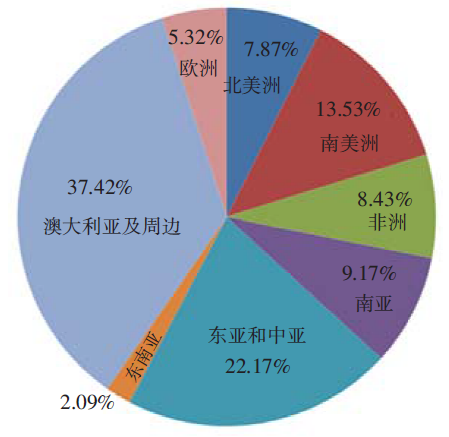
图1 全球各地区盐碱地比例
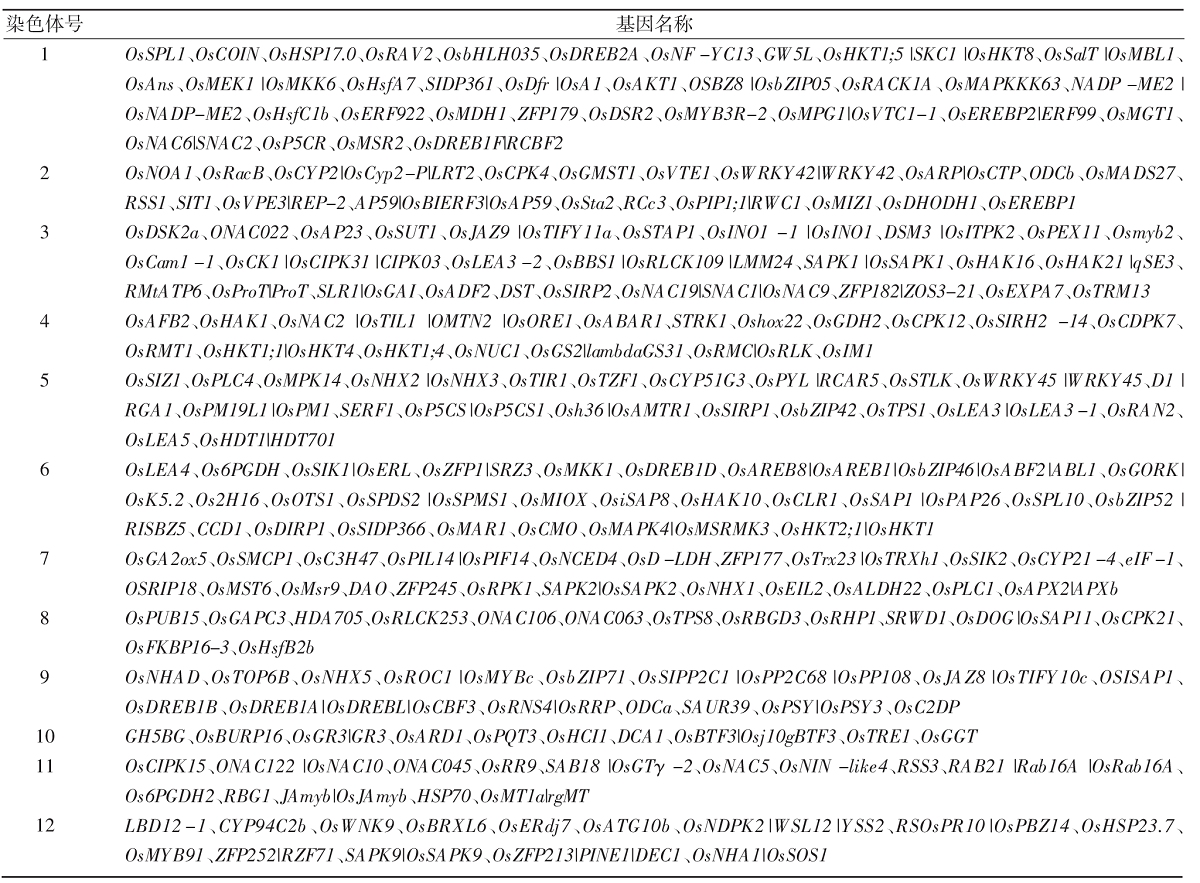 |
表1 水稻耐盐相关基因在水稻染色体上的分布
| |
| [1] | QADIR M, QUILLÉROU E, NANGIA V, et al. Economics of salt-induced land degradation and restoration[J]. Natural Resources Forum, 2014, 38: 282-295. |
| [2] | RENGASAMY P. World salinization with emphasis on Australia[J]. Journal of Experimental Botany, 2006, 57(5): 1 017-1 023. |
| [3] | 魏征, 屠乃美, 易镇邪. 盐碱地对水稻的胁迫效应及其改良与高效利用的研究进展[J]. 湖南生态科学学报, 2019, 6(4):45-52. |
| [4] | LIU M, LIANG Z W, MA H Y, et al. Application of sheep manure in saline-sodic soils of Northeast China 1. Effect on rice (Oryza sativa L.) yield and yield components[J]. Journal of Food Agriculture and Environment, 2010, 8: 524-529. |
| [5] | YANG Y Q, GUO Y. Elucidating the molecular mechanisms mediating plant salt-stress responses[J]. New Phytologist, 2018, 217(2): 523-539. |
| [6] | FERNANDO L H. The performance of salt resistant paddy, Pokkali in Ceylon[J]. Tropical Agriculture, 1949, 105: 124-126. |
| [7] | QIN H, LI Y X, HUANG R F. Advances and challenges in the breeding of salt-tolerant rice[J]. International Journal of Molecular Sciences, 2020, 21(21): 8 385. |
| [8] | 孙明法, 严国红, 王爱民, 等. 水稻耐盐育种研究进展[J]. 大麦与谷类科学, 2017, 34(4):1-9. |
| [9] | 王才林, 张亚东, 赵凌, 等. 耐盐碱水稻研究现状、问题与建议[J]. 中国稻米, 2019, 25(1):1-6. |
| [10] | CHEN R S, CHENG Y F, HAN S Y, et al. Whole genome sequencing and comparative transcriptome analysis of a novel seawater adapted, salt-resistant rice cultivar-sea rice 86[J]. BMC Genomics, 2017, 18(1): 655. |
| [11] | 井文, 章文华. 水稻耐盐基因定位与克隆及品种耐盐性分子标记辅助选择改良研究进展[J]. 中国水稻科学, 2017, 31(2):111-123. |
| [12] | LIN H X, ZHU M Z, YANO M, et al. QTLs for Na+ and K+ uptake of the shoots and roots controlling rice salt tolerance[J]. Theoretical and Applied Genetics, 2004, 108(2): 253-260. |
| [13] | REN Z H, GAO J P, LI LG, et al. A rice quantitative trait locus for salt tolerance encodes a sodium transporter[J]. Nature Genetics, 2005, 37(10): 1 141-1 146. |
| [14] | THOMSON M J, OCAMPO M, EGDANE J, et al. Characterizing the saltol quantitative trait locus for salinity tolerance in rice[J]. Rice, 2010, 3: 148-160. |
| [15] | HE Y Q, YANG B, HE Y, et al. A quantitative trait locus, qSE3, promotes seed germination and seedling establishment under salinity stress in rice[J]. Plant Journal, 2019, 97(6): 1 089-1 104. |
| [16] | TAKAGI H, TAMIRU M, ABE A, et al. MutMap accelerates breeding of a salt-tolerant rice cultivar[J]. Nature Biotechnology, 2015, 33(5): 445-449. |
| [17] | LEI L, ZHENG H L, BI Y L, et al. Identification of a major QTL and candidate gene analysis of salt tolerance at the bud burst stage in rice (Oryza sativa L.) using QTL-Seq and RNA-Seq[J]. Rice, 2020, 13(1): 55. |
| [18] | WU F L, YANG J, YU D Q, et al. Identifification and validation of a major QTL from “Sea Rice 86” seedlings conferred salt tolerance[J]. Agronomy, 2020, 10: 410. |
| [19] | SHI Y Y, GAO LL, WU Z C, et al. Genome-wide association study of salt tolerance at the seed germination stage in rice[J]. BMC Plant Biology, 2017, 17(1): 92. |
| [20] | BATAYEVA D, LABACO B, YE C R, et al. Genome-wide association study of seedling stage salinity tolerance in temperate japonica rice germplasm[J]. BMC Genetics, 2018, 19(1): 2. |
| [21] | YUAN J, WANG X Q, ZHAO Y, et al. Genetic basis and identification of candidate genes for salt tolerance in rice by GWAS[J]. Scientific Reports, 2020, 10(1): 9 958. |
| [22] | KUMAR V, SINGH A, MITHRA S V A, et al. Genome-wide association mapping of salinity tolerance in rice (Oryza sativa L.)[J]. DNA Research, 2015, 22(2): 133-145. |
| [23] | LIU C, CHEN K, ZHAO X Q, et al. Identifification of genes for salt tolerance and yield-related traits in rice plants grown hydroponically and under saline field conditions by genome-wide association study[J]. Rice, 2019, 12: 88. |
| [24] | ZHENG H L, WANG J, ZHAO H, et al. Genetic structure, linkage disequilibrium and association mapping of salt tolerance in japonica rice germplasm at the seedling stage[J]. Molecular Breeding, 2015, 35(7): 1-16. |
| [25] | 李宪伟, 郑洪亮, 赵宏伟, 等. 苏打盐碱胁迫下粳稻芽期耐盐相关性状与SSR标记关联分析[J]. 华北农学报, 2018, 33(2):139-148. |
| [26] | 梁银培, 孙健, 索艺宁, 等. 水稻耐盐性和耐碱性相关性状的QTL定位及环境互作分析[J]. 中国农业科学, 2017, 50(10):1747-1 762. |
| [27] | 李佳锐, 张萃雯, 刘化龙, 等. 盐、碱胁迫下水稻苗期地上部Na+、K+浓度的QTL分析[J]. 华北农学报, 2020, 35(2):21-29. |
| [28] | LI N, ZHENG H L, CUI J N, et al. Genome-wide association study and candidate gene analysis of alkalinity tolerance in japonica rice germplasm at the seedling stage[J]. Rice, 2019, 12(1): 24. |
| [29] | LEI L, HAN Z H, CUI B W, et al. Mapping of a major QTL for salinity tolerance at the bud burst stage in rice (Oryza sativa L. ) using a high-density genetic map[J]. Euphytica, 2021, 217(8): 167. |
| [30] | LI N, SUN J, WANG J G, et al. QTL analysis for alkaline tolerance of rice and verification of a major QTL[J]. Plant Breeding, 2017, 136(6): 881-891. |
| [31] | 冷月. 水稻生殖生长期耐盐性基因位点发掘及候选基因关联分析[D]. 哈尔滨: 东北农业大学, 2020. |
| [32] | 李晶岚, 陈鑫欣, 石翠翠, 等. OsRPK1基因过表达和RNA干涉对水稻苗期耐盐性的影响[J]. 作物学报, 2020,46(8):1 217-1 224. |
| [33] | YUAN X, SUN H, ANG Z B, et al. A novel little membrane protein confers salt tolerance in rice (Oryza sativa L.)[J]. Plant Molecular Biology Reporter, 2016, 34(2): 524-532. |
| [34] | WANG J, NAN N, LI N, et al. A DNA lationreader-chaperone regulator-transcription factor complex activates OsHKT1;5 expression during salinity stress[J]. The Plant Cell, 2020, 32(11): 3 535-3 558. |
| [35] | CHEN G, ZHANG Y, RUAN B P, et al. OsHAK1 controls the vegetative growth and panicle fertility of rice by its effect on potassium-mediated sugar metabolism[J]. Plant Science, 2018, 274: 261-270. |
| [36] | EL-MAHI H, PEREZ-HORMAECHE J, DE-LUCA A, et al. A critical role of sodium flux via the plasma membrane Na+/H+ exchanger SOS1 in the salt tolerance of rice[J]. Plant Physiology, 2019, 180(2): 1 046-1 065. |
| [37] | MARTINEZ-ATIENZA J, JIANG X, GARCIADEBLAS B, et al. Conservation of the salt overly sensitive pathway in rice[J]. Plant Physiology, 2007, 143(2): 1 001-1 012. |
| [38] | YOU J, CHAN Z L. ROS regulation during abiotic stress responses in crop plants[J]. Frontiers in Plant Science, 2015, 6: 1 092. |
| [39] | 刘光宇. 水稻萌发期耐盐基因OsSTG1的克隆与功能分析[D]. 北京: 中国农业大学, 2016. |
| [40] | CHENG X L, HE Q, TANG S, et al. The miR172/IDS1 signaling module confers salt tolerance through maintaining ROS homeostasis in cereal crops[J]. New Phytologist, 2021, 230(3): 1 017-1 033. |
| [41] | CHEN T X, SHABALA S, NIU Y N, et al. Molecular mechanisms of salinity tolerance in rice[J]. The Crop Journal, 2021, 9(3): 506-520. |
| [42] | HONG Y B, ZHANG H J, HUANG L, et al. Over-expression of a stress-responsive NAC transcription factor gene ONAC022 improves drought and salt tolerance in rice[J]. Frontiers in Plant Science, 2016, 7: 4. |
| [43] | ZHANG X, LONG Y, HUANG J J, et al. OsNAC45 is involved in ABA response and salt tolerance in rice[J]. Rice, 2020, 13(1): 79. |
| [44] | XU N, CHU Y L, CHEN H L, et al. Rice transcription factor OsMADS25 modulates root growth and confers salinity tolerance via the ABA-mediated regulatory pathway and ROS scavenging[J]. PLoS Genetics, 2018, 14(10): e1007662. |
| [45] | WANG Y Y, CHEN W X, XING M, et al. Wild rice GL12 synergistically improves grain length and salt tolerance in cultivated rice[J]. Nature Communications, 2024, 15(1): 9 453. |
| [46] | JIANG L L, XIAO W Y, CHEN H P, et al. The OsGAPC1-OsSGL module negatively regulates salt tolerance by mediating abscisic acid biosynthesis in rice[J]. New Phytologist, 2024, 44(3): 825-839. |
| [47] | NIE S S, HUANG W T, HE C C, et al. Transcription factor OsMYB2 triggers amino acid transporter OsANT1 expression to regulate rice growth and salt tolerance[J]. Plant Physiology, 2025, 197(2): 559. |
| [48] | XIE T, XU J Y, HU W L, et al. OsAAH confers salt tolerance in rice seedlings[J]. The Plant Journal, 2024, 120(5):1954-1 968. |
| [49] | LIU X, GUO X, LI T J, et al. OsGSK1 interacts with OsbZIP72 to regulate salt response in rice[J]. The Plant Journal, 2025, 121(6): e70112. |
| [50] | 刘莉. 盐胁迫下植物激素对水稻种子萌发及幼苗根系生长的调控机理研究[D]. 武汉: 华中农业大学, 2019. |
| [51] | KADER M A, LINDBERG S. Cytosolic calcium and pH signaling in plants under salinity stress[J]. Plant Signaling and Behavior, 2010, 5(3): 233-238. |
| [52] | 谢国生, 朱伯华, 彭旭辉, 等. 水稻苗期对不同pH值下NaCl和NaHCO3胁迫响应的比较[J]. 华中农业大学学报, 2005, 24(2):121-124. |
| [53] | 王娟, 李德全. 逆境条件下植物体内渗透调节物质的积累与活性氧代谢[J]. 植物学通报, 2001, 18(4):459-465. |
| [54] | 杨春武. 虎尾草和水稻抗碱机制研究[D]. 长春: 东北师范大学, 2010. |
| [55] | 易善军, 孙振元, 韩蕾, 等. 植物耐碱机理及相关基因研究进展[J]. 世界林业研究, 2011, 24(1):28-32. |
| [56] | KHARE T, KUMAR V, KISHOR P B K. Na+ and Cl- ions show additive effects under NaCl stress on induction of oxidative stress and the responsive antioxidative defense in rice[J]. Protoplasma, 2015, 252: 1 149-1 165. |
| [57] | MORADI F, ISMAIL A M. Responses of photosynthesis, chlorophyll fluorescence and ROS-scavenging systems to salt stress during seedling and reproductive stages in rice[J]. Annals of Botany, 2007, 99: 1 161-1 173. |
| [58] | MSANNE J, LIN J S, STONE J M, et al. Characterization of abiotic stress-responsive Arabidopsis thaliana RD29A and RD29B genes and evaluation of transgenes[J]. Planta, 2011, 234(1): 97-107. |
| [59] | 魏立兴. 外源脱落酸对水稻(Oryza sativa L.)盐碱胁迫的诱抗效应及其生理机制[D]. 北京: 中国科学院大学, 2015. |
| [60] | LE H L, LINH T H, XUAN T D, et al. Molecular breeding to improve salt tolerance of rice (Oryza sativa L.) in the Red River delta of Vietnam[J]. Journal of Integrative Plant Genomics, 2012, 2012: 949 038. |
| [61] | BABU N N, KRISHNAN S G, VINOD K K, et al. Marker aided incor-poration of Saltol, a major QTL associated with seedling stage salt tolerance, into Oryza sativa ‘Pusa Basmati 1121’[J]. Frontiers in Plant Science, 2017, 8: 41. |
| [62] | YU J, ZHU C S, XUAN W, et al. Genome-wide association studies identify OsWRKY53 as a key regulator of salt tolerance in rice[J]. Nature Communications, 2023, 14(1): 3 550. |
| [63] | LIU G Y, JIANG W X, TIAN L, et al. Polyamine oxidase 3 is involved in salt tolerance at the germination stage in rice[J]. Journal of Genetics and Genomics, 2022, 49(5): 458-468. |
| [64] | DENG P, CAO C J, SHI X Y, et al. OsCYBDOMG1, a cytochrome b561 domain-containing protein, regulates salt tolerance and grain yield in rice[J]. Theoretical and Applied Genetics, 2023, 136(4): 76. |
| [65] | XIANG Y H, YU J J, LIAO B, et al. An α/β hydrolase family member negatively regulates salt tolerance but promotes flowering through three distinct functions in rice[J]. Molecular Plant, 2022, 15(12): 1 908-1 930. |
| [1] | 申红芳, 张健, 姜仁华. 以水稻科技创新引领产业新质生产力发展:基于第一届水稻科技大会观点综述[J]. 中国稻米, 2026, 32(4): 1-4. |
| [2] | 闫治霖, 吴慧扬, 窦志, 高辉. 稻渔共生种养绿色高效新质技术研究进展[J]. 中国稻米, 2026, 32(4): 108-110. |
| [3] | 张珍, 陈惠哲, 张玉屏, 向镜, 张义凯, 徐逸文, 王亚梁, 王志刚. 水稻集中育供秧技术及不同抛秧方式应用研究[J]. 中国稻米, 2026, 32(4): 111-115. |
| [4] | 华兆才, 王均辉, 王利民, 黄东风, 梁永英, 林伟明, 吕荣海, 陈福科. 猪粪浆肥替代化肥对闽西南双季稻产量、养分吸收和土壤理化性质的影响[J]. 中国稻米, 2026, 32(4): 116-121. |
| [5] | 阳庆华, 鲁孟海, 别文力. 三系杂交水稻制种纯度保障技术研究:现状、成因与提升策略[J]. 中国稻米, 2026, 32(4): 122-124. |
| [6] | 李凤博, 冯金飞, 方福平. 水稻对养殖池塘磷负荷的消减效应及其研究进展[J]. 中国稻米, 2026, 32(4): 25-30. |
| [7] | 李先婷, 张诗倩, 张金霞, 章怡静, 张佩佩, 丰柳春, 姬生栋, 解晶, 桑世飞. 水稻抗性淀粉含量调控的分子机制及精准遗传改良研究进展[J]. 中国稻米, 2026, 32(4): 31-36. |
| [8] | 徐雯, 田婷, 荆培培, 杨洪建. 基于不同生育期高光谱遥感影像的水稻产量估测模型研究[J]. 中国稻米, 2026, 32(4): 37-42. |
| [9] | 汪璐璐, 张翔, 朱旺, 耿孝宇, 左博源, 马唯一, 陈英龙, 高平磊, 戴其根, 周桂生, 韦还和, 孟天瑶. 盐胁迫下水稻根系特征及其对产量形成与温室气体排放的影响研究进展[J]. 中国稻米, 2026, 32(4): 60-65. |
| [10] | 杨昊龙, 胡赞民, 苏燕贵. 硒硅对铬胁迫下水稻生理生化、元素吸收及铬亚细胞分布的影响[J]. 中国稻米, 2026, 32(4): 66-73. |
| [11] | 胡津辅, 黄富春, 鲁旭鹏, 杨文胜, 朱建强, 李经勇. 保护性耕作耦合种植密度对水稻产量及稻田碳氮平衡的协同调控[J]. 中国稻米, 2026, 32(4): 79-85. |
| [12] | 李健雄, 李梦兴, 黄章慧, 柯达, 朱素素, 陈建酉, 涂从勇. 现代水稻育种科技平台建设实践与思考:以广东省农业科学院水稻研究所为例[J]. 中国稻米, 2026, 32(4): 86-90. |
| [13] | 金成海, 李佳, 严永峰, 陈莫军, 齐春艳, 孟凡梅, 朴日花. 基于SNP标记和表型的吉林省水稻主导品种遗传多样性研究[J]. 中国稻米, 2026, 32(4): 91-96. |
| [14] | 韩容, 沈光辉, 扶定, 常幸远, 霍二伟, 张凯璇, 徐士库, 郭桂英, 胡杨, 李歌星, 余林闯, 陈庆明, 陶丛旺. 水稻两系不育系信32061S特性、遗传分析及应用[J]. 中国稻米, 2026, 32(4): 97-101. |
| [15] | 张锋, 孙阳, 徐得泽, 满建国, 曹鹏. 湖北水稻大面积单产提升现实制约与实现路径[J]. 中国稻米, 2026, 32(3): 1-4. |
| 阅读次数 | ||||||
|
全文 |
|
|||||
|
摘要 |
|
|||||
